Showing posts with label book review. Show all posts

Wednesday, May 27, 2015

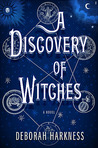
A Discovery of Witches (All Souls Trilogy, #1)A Discovery of Witches by Deborah Harkness
My rating: 3 of 5 stars

A Discovery of Witches by Deborah Harkness is the first book in the All Souls Trilogy. It weaves fantasy, history, and magic into a fascinating tale of forbidden love between a vampire and a witch. Harkness's interpretation of history with sprinkles of magic creates a story that is believable and well researched. Her detailed descriptions of events and setting adds depth to the story. Often times her descriptions of Oxford made me think I was still there. If you are a writer looking for examples of good scene and setting descriptions, this book is full of them.

There were times when I thought the characterization was flat. At first, I did not like her characters, especially Diana Bishop but, as the novel progressed, so did the characters. Their actions began to make sense, but it takes almost 500 pages into the story for that to happen. There were also times when the vocabulary used was redundant (the vampire purrs too much). Harkness spends so much time and thought on background information but does not give the same attention to the foreground. The storyline is brilliant but the story itself is slow in its pursuit of the plot.

If you love history and fantasy with a lot of time on your hands, then this book is for you.

View all my reviews

Sunday, March 1, 2015

Isabella: The Warrior Queen by Kirstin Downey


Isabella: the Warrior Queen by Kirstin Downey is a revisionist history of Isabella of Castille. In this work, an investigation of Isabella's role as queen demonstrates a woman's aptitude in governing and the lengths taken to disguise the power of a female sovereign. Not only did Queen Isabella competently rule Castille, but she left her mark on the political landscape of European royalty and contributed to the future of the New World. Downey beautifully explained Queen Isabella's impact. Beginning with her childhood and working her way through the events of Isabella's lifetime, Downey's extensive investigation of the background and culture made the story come alive. 

Downey is eloquent and thoughtful of her portrayal of Isabella, but she makes sweeping claims that make me question her sources. For example, there are frequent references to possible poisoning when someone dies during a time period when people often passed away from unknown illnesses. It might make for a more fascinating read but is not a scholarly approach, especially since there is no science to back up the claim. I also question her statements regarding the Muslim slave trade. The numbers seem rather high, especially given the time period. There had been a plague that swept through Europe, decimating the population of much of the continent. If the Muslims had captured as many slaves as claimed in Isabella, then there would not be anyone left in the cities and countryside of Europe. The Muslim invasion of the Christian world was greatly feared, but I sense some exaggeration in regards to the slave trade. 

The most fascinating aspect of Isabella is the portrayal of Isabella's marriage to Ferdinand. They were the ultimate Renaissance power couple, and Downey illustrates convincingly how Isabella was the real power behind the couple. Isabella wisely manipulated her hold on the power of Castille, participated in the wars against the Muslims and squashed civil unrest, supported overseas ventures in the New World, and created alliances with the most powerful nations in Europe through marriages with her children. One of the best evidence to support her claim of Isabella's authority is how Ferdinand reigned after Isabella's death.

Isabella: the Warrior Queen is a captivating story and one I would recommend. Downey gives an absorbing and stimulating account of Queen Isabella's life and is well worth reading.

Saturday, October 11, 2014

Hitler's Furies: German Women in the Nazi Killing Fields by Wendy Lower


Hitler’s Furies is a remarkable story of German women whose participation in the Holocaust contributed to the deaths of millions on the Eastern Front. Wendy Lower follows the intriguing stories of twelve women whose loyalty to Adolf Hitler and desire for a better life propels them to commit atrocities to Jewish people.  The story Lower presents is one of normal, every day women who are products of their time. Lower beautifully demonstrates how their background as women coming of age after the defeat of World War I and the emergence of the Nazi party helped to cultivate them into being comfortable with racism, which in turned created an atmosphere where there is no question of morality when Jewish people are concerned. Lower’s research highlighted the atrocities committed by these women using interviews and documents found in Russian and German archives. Although some evidence has clearly been destroyed after the war either through warfare or the purposeful destruction of documents, Lower makes a good case against these women who got away with murder; however, the numbers she uses are not always substantiated by the evidence she presents in Hitler’s Furies. For example, her claim that over a half-million women are culpable and should be exposed and prosecuted is not convincing because of the lack of evidence. Lower admits that the documentation is not there to substantiate this overwhelming claim. 

Wednesday, May 21, 2014

The Maid and The Queen: The Secret History of Joan of Arc by Nancy Goldstone


The Maid and the Queen: The Secret History of Joan of ArcThe Maid and the Queen: The Secret History of Joan of Arc by Nancy Goldstone
My rating: 3 of 5 stars

The Maid and the Queen... is a non-fiction historical narrative about the role that Yolande of Aragon played in the eventual end of the Hundred Years War. The title of the book is misleading because the book revolves mainly around Yolande and her achievements while Joan of Arc plays a minor role in the narrative. In my opinion, the accounts of the sacrifices and intrigues Yolande was involved in and her role in ending the war between France and England are truly more fascinating than Joan of Arc's martyrdom. Nancy Goldstone spins the tale beautifully and weaves the mysterious and the intrigues into an understandable and readable narrative perfect for history lovers. Although The Maid and the Queen... is beautifully written, there are several aspects that are purely conjecture with no historical evidence - only coincidences and guesswork, especially the connection between Yolande and Joan (the premise of the book). Although The Maid and the Queen... is a good read, it should be noted that the author did not prove her thesis, "So accomplished a statesman was Yolande, and so cleverly did she hide her tracks, that the myth that Joan of Arc appeared at Charles's court and convinced the king of his birthright unaided by any mortal being has stood unchallenged for nearly six hundred years. Still, if it is accepted, as it is often said that without Joan of Arc there would be no France, it is also true that without Yolande of Aragon there would have been no Joan" (249). There are some coincidences that Goldstone points out such as her son being in the position to help Joan meet with the Dauphin that does not solidly prove the premise of the narrative. It does, however, make for an interesting tale.

View all my reviews

Sunday, February 23, 2014

Queen of the Conqueror: The Life of Matilda, Wife of William I by Tracy Borman

Photo by Regina Horne Beard.  


Queen of the Conqueror: The Life of Matilda, Wife of William IQueen of the Conqueror: The Life of Matilda, Wife of William I by Tracy Borman
My rating: 3 of 5 stars

Many have heard of William the Conqueror, but few know of his wife, Matilda of Flanders. In this biography, Tracy Borman examines Matilda's life in a passionate prose that draws the reader into the narrative. Although Queen of the Conqueror is well researched, there is too much attention placed on rumors about Matilda written centuries after her death. The author is correct in addressing later writers who slander Matilda to point out that misogyny is the main reason historians know so little about her or any other powerful medieval woman; however, the rumors and myths should have been brief since her thesis focused on Matilda's ambition and personality as the driving force to her power and influence over her husband. Borman should have focused solely on academic sources to draw a more substantial picture of Matilda. The combination of the slander and the authentic vision of Matilda left this reader a little fuzzy as to who the Conqueror's queen really was. Otherwise, Queen of the Conqueror is a fascinating tale of a competent, powerful woman for any audience interested in the history of England and Normandy.

View all my reviews

Tuesday, September 24, 2013

Readers’ Review of Expectations


There is really nothing more encouraging for a writer than an awesome review. Receiving good reviews is probably one of the best parts about writing. I love to share my work and I find it especially rewarding when someone enjoys my writing and appreciates the presentation and the individuality. The following review was originally posted on Readers’ Favorites and can be found on Barnes and Nobles and Google Books.

Reviewed by Mamta Madhavan for Readers' Favorite

Expectations by Regina Horne Beard is a collection of poems that speaks about the common human emotions that we experience in our lives. The poems are all written in free verse and teach us how to go on a path of intellectual, mental, and spiritual growth.
I enjoyed reading the poems. Poetry is always interesting because each poet has their own way of expressing their observations and thoughts. That means, although the emotions are the same, the way of presentation and the way of expressing them will be unique and will reflect the individuality of the poet. The poems stay true to the title, Expectations. All the poems are about relationships and our expectations. The author has managed to deal with the truth and write an emotional collection of poems that is soul-stirring and heart-rending for the readers.

The love poems like 'Desert Prince' and 'Our Life' show the softer and romantic side of the poet. 'Closure' is a beautiful poem on the closing of a relationship. The poet has handled the theme very well without going overboard. The language is crisp, minimalist, and very effective. 'Parcae' has a lot of sadness in it. 'The Enchanter' speaks about passion and desire. That is again one poem where the poet has used minimalism to enhance the powerful emotions.

I would recommend this book to poetry lovers. The emotions are connected and the poet handles a theme that all of us can understand very well.

*********

This is the second review I received that specifically mentions the poems “Our Life” and “Closure,” and the first to mention my favorite poem “The Enchanter.” It’s interesting the poems that people remember and reflect on. About a month ago, I had an extended email correspondence with one fan about “Closure.” He commented that it is often the most painful experiences in life that inspire the best work. After giving it some thought, I had to agree with his assessment. While in college, I studied history and it seemed that during times of trouble and strife, the best works of art and literature were created. For example, after the defeat of the Persians under Xerxes, art, architecture, and literature flourished in Athens, which included the building of the Parthenon. On a more microscopic scale, particular moments in our lives can inspire us to create our best work. I think “Closure” fits into this scenario nicely. “Closure” is a reflection on the darkest period in my life, a time I wish I could forget.

“Our Life” is a happy poem about love. Most of the poems I write tend to be more sad than happy, which is not a reflection on me. I’m a happy person and always smiling and laughing. Love, however, is not always a happy experience, which is why it fascinates me so much. Love can be amazing, but it can also be heartbreaking. Love is a conundrum. “Our Life” is one of those amazing love moments. It describes the depth of every day love. Some may think that this kind of comfortable love is boring but, in fact, every day love is what will sustain you. Every day love is what gives a couple the strength to withstand the cruelty of the world. It is the light that penetrates the darkness. You may not be able to live on love, but love can help you cope with life because this is the kind of love that gives hope. 

“Desert Prince” is a poem I wrote when I was in high school. It is a fantasy poem of a day dream. When I was younger, I wanted to be rescued more than anything. I did not like where I was or where I was going and, as crazy as it sounds to me today, I thought a man could change all of that. My expectations about love and life were quite fanciful back then.

“Parcae” is Latin for the Fates. According to Greek mythology, the Fates controlled the destinies of humans by weaving the Thread of Life on a loom. In this poem, I wrestle with the idea of a love that was destined to end permanently and irrevocably and coping with the pain that followed the breakup. It is definitely an unhappy poem.

“The Enchanter” is a poem about desire and the hypnotic trance a new lover can inflame. It was written in September 2000 for a Creative Writing class I was taking. It is my favorite because it is perfect in rhyme, meter, and theme. The vocabulary and the syntax are all hallmarks of poetry written by me. I view “The Enchanter” as a signature piece.

Mamta Madhavan is the first reviewer to point out that I use minimalism in my poetry. There are many different aspects to poetry that gives a poem its character. It is not only important to choose the correct words, but it is also crucial to use the right sentence length to enhance the emotion of the words. Madhavan understood that, and I appreciate her pointing it out. It’s great to have someone do such a wonderful job reviewing. She read, dissected, and translated my work beautifully. She understood the subtle nuances of poetry and applied them to my poems. Reviews don’t get much better than this!

The book trailer for Expectations: