Showing posts with label book trailer. Show all posts

Saturday, January 20, 2018

Creating a Family Cookbook

A mockup of the cookbook.

For Christmas this year, I wanted to do something special. I wanted to create a collection of family recipes that also included a little family history. I really didn't like the layouts I found online, and I wanted something more creative and fun. They looked too impersonal and too much like a church fund-raiser. I did find some nice templates for cookbooks with iBook Author that are ready to use. All you have to do is drop in photographs and videos and then copy and paste recipes. I liked the cover for one of the templates and decided to use it for this project. Since I did not have a lot of media to use in creating the cookbook, I used Book Creator on my iPad. In fact, this entire book was created using an iPad. 


The first step in any project is to get organized. I used Evernote to keep the recipes and photographs I collected for the project. Every time my aunts or cousins contacted me with a new recipe to add, I immediately added it to Evernote so I didn't lose it. This also made it easier to copy and paste recipes into the book. When I added a photograph to Evernote, I noted who was in the photograph, where the photograph was taken, the date of the photograph, and who gave it to me. As a family historian, I understand that the more information included with an artifact, the better. 

Since the late 1980s, I've been keeping records of my family history. I've recently digitized my collection and shared most of it online using FamilySearch.org. It's a free website that is a collaborative effort at documenting genealogy. I still maintain a paper archive of records, but I also keep a digital copy of everything in Evernote. Over the summer, I completed a two-year scanning project of family photographs. There were over 10,000 digital items scanned by the end of last summer. Of course, you do not have to go through this much trouble to put together a simple cookbook. Since I've been doing all of this research, I decided to share some of it in the cookbook.

There are no templates in Book Creator so you will be starting from scratch. The app is user-friendly and one that I frequently use for projects. You can add photographs, video, and recordings. When you finish a project, you can save it as an epub, pdf, or a video file. Before you begin, decide exactly how you want the book to look and what you want to include in the book. This will save you a lot of time. The elements I included in my book are:

Cover page
Title page
Copyright
Acknowledgments
Introduction
Family trees
Recipes

Project layout in Book Creator.

As I mentioned before, I used a cover photo I found in iBook Author as my cover for this project. I changed it to look the way that I wanted it to look. Then I made a screenshot of the cover page and added it to Book Creator. Adding a title page may seem redundant, but it is also a necessary one. A title page gives a clear copy of the title, author/editor, and publication. 

The title page

My next pages are the copyright page and acknowledgments. Any work that you do, you should sign and date it and that's what I used the copyright page for. On this page, I included my name, the title, my self-publication identity (Farmhouse publishers) along with the location and date. On the following page, I wanted to give credit to the people who helped me with the project. I make it a rule to say thank you because not everyone is willing to help. 

Copyright and Acknowledgment pages.

Every work needs to have a written statement of purpose. In my introduction, I stated the purpose of the book as well as how I gathered the recipes and the photographs. As a keepsake, it is important to document the how, why, and when. I wanted to be sure that years from now when my great, great-granddaughter picks up a copy of this book, she will be in no doubt of its intentions or its documentation. 

The introduction.

The addition of the family trees in the cookbook was an attempt to connect the present with the past. It also identified the people who contributed recipes and how we are all related. One of the most confusing aspects about genealogy is when people write their family stories, they call their relatives "grandma" or "dad" or "mother" and I lose track as to who exactly they are talking about. I try to avoid doing this. It may seem strange to call my grandmother by her name, Willeen, but it will be clear to those who pick up my work as to who I am talking about. With this dilemma in mind, I made sure to add a family tree for easy reference. I used the family tree that is created on FamilySearch.org. There is a Portrait Pedigree Chart that can be downloaded for any ancestor. I used the charts for my paternal grandfather and my maternal grandmother. 

Horne Family Tree
Spears Family Tree

The final section of the cookbook is the recipes. I decided on two layouts designs for the pages. I wanted to keep them simple without a lot of color to keep the price down when printing them out and sharing with relatives. The first layout includes the recipe and a photograph of the family.


The second layout design is the recipe with a profile photograph of the person who created the recipe.


You can organize your recipes in any way that you want. I only had a handful of recipes, so I dispersed them haphazardly throughout the book with no real organization in mind outside of aesthetics. When I finished the project, I saved the file as a .pdf - one "side by side pages" for viewing on a tablet and one file as "single pages" for printing. I also saved it as a video file to use for an advertisement video. The unedited video runs 4:44 minutes long and is incredibly boring when it is not edited.

You can find a free download of the cookbook on my website!

The printed edition of The Family Table.


Book trailer.

Monday, March 28, 2016

Digital Scrapbook: Ireland, Wales, and England


Last spring break (March 2015), I had the opportunity to travel to Ireland, Wales, and England as a group leader to six teenagers. It was a unique and rewarding experience and one I won't soon forget. When we returned, I spent the next few months working on a digital scrapbook commemorating the trip.

I used Book Creator for iPad, which is one of my favorite apps for creating books outside of iBook Author. In my opinion, the $4.99 price tag for Book Creator is money well spent. I find that I turn to it for projects I want to quickly put together. The app allows you to add audio and video to your book and has a feature that turns your book into a video.

In Ireland, Wales, and England, I documented the daily activities on the tour as well as the sites we visited to create a visual narrative that includes pictures, videos, and short descriptions. The first video (playlist) was created using an iMovie trailer theme:


A few of the videos were created using a variety of video editing apps, including Drop 'N' Roll, Replay, Vont, and Fliptastic. Photographs were edited using the Martha Stewart Craft Studio and Photo Tangler. At some of the sites we visited, I was quite the shutterbug and took an absurd amount of pictures. Instead of having page after page of boring pictures, I turned them into a short video. Here is an example from my visit to the Archaeology and History Museum in Dublin, Ireland:


Mixed with the photographs are screen shots of some of my social media posts from the trip. Modern technology allows for easy communication with people back home. The first time I traveled outside of the country, the Internet was a new thing and mass emails was the easiest way to stay connected. Today with Facebook, Twitter, and Instagram, staying connected is in real time. I can check-in at Buckingham Palace in London and friends and family back home (if they're awake) know immediately. It was fun to include the posts in the photographic narrative:


Once I had all of the pictures and photographs in place, I was ready to turn the scrapbook into a video. To create a video, click on the share icon and then on "Export as Video," which will save the video to your camera roll.


When the video is uploaded to the camera roll, I then opened it in iMovie and did some more editing to it. One of the main bits of editing I did was to add audio to dull areas in the video. These were mainly the portions of the video that showed photographs lying flat on a page. A great source for free music that can be shared in videos for free can be found at the YouTube Audio Library. They have a variety of different music that can be searched by mood, genre, length, etc. It is a great source if you're on a budget. The video also plays the short videos that were added to the book, but they were small on the screen. In a book, this would not be a problem because a video can easily go to full screen. In the video, however, it was just too small. I simply deleted the sections showing the short videos and inserted the original footage into the timeline, using transitions as a clean segway in between scenes.


I'm still using DVDs for movies so, of course, I had to burn a copy to a DVD and make a matching cover. To burn to a DVD, I used DVD Creator Pro Burn Video ($14.99) for Mac, which is a simple and intuitive software that lets you add background pictures as well as audio. To create the cover and the sticker for the DVD I used Pages. 


Book download

When I began this project, I had no intentions of turning the scrapbook into an .epub that can be viewed on my iPad, but I have changed my mind. Had I originally intended to create an electronic book, I would have created it using iBook Author instead because of the massive size of the files. With iBook Author, you can decrease the size of your book by using the YouTube widget instead of uploading individual videos. On the Book Creator app, the size of my final book is 2530 MB. Crazy, huh? Perhaps one day soon some genius will figure out how to have a media rich book without ending up with an incredibly large file. Until then, I will have to make due with many volumes to the work.

To download a copy of the scrapbook, click on the link to the volume you wish to see. If you are using your iPad, simply click on the "Open in" tab and open the document in iBooks or your favorite .epub reader. If you are on your Mac, click to download the file and save it to your computer. Then click on the file and it will open automatically in iBooks. 

Please note: these files cannot be read on a Kindle. You must either have iBooks or an .epub reader to view.

Vol. 1: The introduction and first two days in Ireland, including a visit to Adare and Killarney.

Vol. 2: Finishes the second day in Ireland and continues into the third day, which includes a tour of the town of Killarney and the beginning of the Ring of Kerry with a stop to see the Atlantic Ocean at Dimple Peninsula.

Vol. 3: Continues along the Ring of Kerry, highlighting the sheepdog demonstration and a stop at Sneem.

Vol. 4: Continues along the Ring of Kerry with stops at the Kerry Bog Village and the Ladies' View.

Vol. 5: Begins day four at Blarney Castle, Cashel Rock, and Dublin.

Vol. 6: Begins day five with a look at St. Patrick's Cathedral (a short book with only 15 pages because of the size of the video of St. Patrick's).

Vol. 7: Finishes day five with an exploration of Dublin, including Trinity College. Day six begins with a ferry ride across the Irish Sea to Wales and the beautiful Beaumaris Castle.

Vol. 8: Begins day seven at Stratford-Upon-Avon (a short book with only 13 pages because of the size of the video of Stratford-Upon-Avon).

Vol. 9: Continues day seven with a stop at Oxford before continuing on to London (another short book with only 11 pages because of the size of the video).

Vol. 10: Finishes day seven in London (small book with 11 pages because of the size of the video).

Vol. 11: The final volume covering day eight with more sites of London (one video removed because it was too long to allow the file to upload from Book Creator). This volume includes Buckingham Palace, a stop in Windsor, and a concluding video.

I hope these volumes leave you inspired and ready to create your own digital scrapbook!

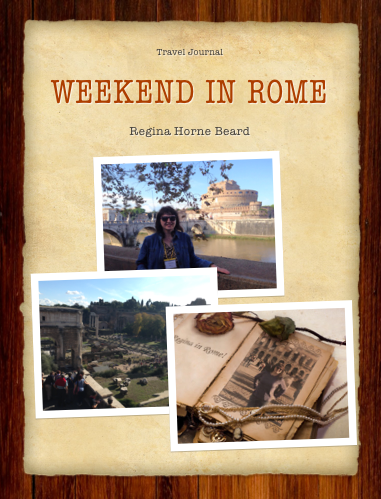
A few months before going to Ireland, Wales, and England, I went to Rome. When I returned, I created a digital scrapbook using iBook Author on my Mac. To check out step-by-step how I created Weekend in Rome, click on this link.

Another way to commemorate a trip or event is to make a memory quilt. You can check out mine at I Tried That Crafter blog.

Sunday, December 7, 2014

Interactive Scrapbooking and Travel Journals

Recently I experienced my first trip to Rome, Italy. It was a whirlwind weekend of sightseeing, food, and fun. As you may know from previous blog posts, I am completely obsessed with history and mythology. Being able to see Rome firsthand was an incredible opportunity for me. After returning home and reflecting over the experience, I decided to create an interactive travel journal. While growing up, I often put together scrapbooks and journals and continued the trend in adulthood, except now I use a computer instead of construction paper. Since my conversion to Apple products, I have created an iBook for all my interest. With the variety of interactive features, I can create some memorable and entertaining books for my iPad, including my most recent addition, Weekend in Rome.

Since Weekend in Rome is a travel journal, I wrote the chapters first. Like everything else I write, I edited and proofread and let others look over the chapters until I was satisfied with the narrative. Next, I chose the pictures I wanted to use for the book. I knew this was going to be a media rich presentation with pictures and videos, so I took over a thousand pictures and forty videos while I was there. No kidding. I seriously took over a thousand pictures. Always, always take a bunch of pictures. It does take many pictures before you are able to get the really good shots. Once you are organized, then choose what format and template you are going to use for the book. At the App store on your iPad there are several apps on the market that can be used to create different kinds of books. My favorite one to use is Book Creator. There is a free version, but it is certainly worth the $4.99 to upgrade. If you want something a little more sophisticated like I did, then you can use a template from iBook Author, which has many to choose from and includes a handful that are free. The one I chose, called "Travel Book," can be found on iBook Author's website for $19.99. It was easy to use and had several different matching designs that worked great for the vision I had for this project.

As soon as I decided on which designs I wanted to use, I then copy and pasted the text into the book. After the text was in place, it was easy to insert the pictures and the videos where they enhanced the narrative. I wanted the introduction media at the beginning of the book to be memorable, fun, and short, so I used a trailer template on iMovie, using various pictures and videos from the trip that were my favorites. I also changed the setting so that when someone opens Weekend in Rome for the first time, the video will automatically begin playing. The iBooks in my library that automatically play the introduction video (and do it well) are the ones that are my favorite because the media pulls you immediately into the book and the story. It is as if your imagination is ready to be off and running. My only problem with the video is the typo I found after deleting the project from my iPad. It is a good example of how you cannot proofread enough.


I also had some .pdf documents I wanted to include in the book, so I used a .pdf widget from Bookry.com, which is a website that has many free widgets to choose from including Google maps, forms, galleries, and more. A helpful widget that can keep your iBook at a reasonable size is the YouTube widget. Adding media to an iBook can make the project huge. If that is a concern, then you should definitely upload your videos to YouTube and use the widget instead of dropping your videos into the iBook. After you choose the widget you want to use, you can personalize the widget online. When the widget is ready to be used, simply download the file to your computer and then drop it into the iBook. To make the widget more appealing, I dropped a .jpeg (in this case, it was the EF Tours logo) onto the widget in the iBook. The beauty of widgets on Bookry.com is that if I change anything in my account online, the widget in the iBook will also change once it's been updated.


Another element I wanted to include were some of the posts I made while in Rome from my favorite social networks. I enjoy using social media and I use it heavily - perhaps too heavily for the tastes of my friends and family. I think that popular social media like Facebook, Instagram, and Twitter tell the modern story of humanity, and there is something truly beautiful about first person accounts of every day lives. I took a few screen shots and dropped the pictures of the posts into the iBook and adjusted the setting on the pictures for them to go into full view when they have been clicked. The example below is a post I made to Facebook about the Pantheon:


Whenever I completed my scrapbook, I clicked on "File" along the top of the menu bar and then "Export." Then click on "iBooks" (unless you would rather download it as a .pdf or text document, but none of the interactive features will work in those formats). Since Weekend in Rome is a travel journal with private reflections, I saved the file to my computer instead of the iTunes store. If you want to make the iBook public and publish to the iTunes store, then click on the "Publish" button along the top menu and follow the instructions. Sorry, you will not be able to get your hands on this edition of Weekend in Rome, but you can easily create your own book of treasured memories. It's definitely worth the time and effort. Below is a short video preview of the finished book just to give you some ideas and a creative boost:


Sunday, May 11, 2014

Cassandra's Curse

Why aren't you listening to me?
Is it that hard to see
The meaning I try to convey
With each word I say?
I cry through tears
But still you won't hear
Of the future woes,
Being overthrown by the foe,
The gift we should dread
Because tomorrow we'll all be dead-
All falls on deaf ears.
Ears that just won't hear.
If Apollo had this to warn
Would you all still scorn
All the words I've said
To the future dead?
My words have merit - you'll see.
But my reward is apathy.

~from Expectations by Regina Horne Beard

The book trailer for Expectations:

Friday, February 14, 2014

The Enchanter


The book trailer for Expectations:

Monday, January 6, 2014

Our Life


The book trailer for Expectations:


Monday, December 2, 2013

Book Trailer for Expectations by Regina Horne Beard


Expectations
filmed in Arkansas at
Lake Greeson Wildlife Management Area
and
Camp Charlton


This eclectic collection of poetry explores love, rejection, abuse, loneliness, and history with an eye on the expectations we place on each of them. Expectations is a life journey, experiences familiar to every human soul - the feelings of loss, confusion, and heartbreak. It is a story of emotional, spiritual, and intellectual growth set to prose with a unique blend of free verse and free rhyme. $2.99


Purchase your copy of Expectations from one of the following vendors:


Tuesday, September 24, 2013

Readers’ Review of Expectations


There is really nothing more encouraging for a writer than an awesome review. Receiving good reviews is probably one of the best parts about writing. I love to share my work and I find it especially rewarding when someone enjoys my writing and appreciates the presentation and the individuality. The following review was originally posted on Readers’ Favorites and can be found on Barnes and Nobles and Google Books.

Reviewed by Mamta Madhavan for Readers' Favorite

Expectations by Regina Horne Beard is a collection of poems that speaks about the common human emotions that we experience in our lives. The poems are all written in free verse and teach us how to go on a path of intellectual, mental, and spiritual growth.
I enjoyed reading the poems. Poetry is always interesting because each poet has their own way of expressing their observations and thoughts. That means, although the emotions are the same, the way of presentation and the way of expressing them will be unique and will reflect the individuality of the poet. The poems stay true to the title, Expectations. All the poems are about relationships and our expectations. The author has managed to deal with the truth and write an emotional collection of poems that is soul-stirring and heart-rending for the readers.

The love poems like 'Desert Prince' and 'Our Life' show the softer and romantic side of the poet. 'Closure' is a beautiful poem on the closing of a relationship. The poet has handled the theme very well without going overboard. The language is crisp, minimalist, and very effective. 'Parcae' has a lot of sadness in it. 'The Enchanter' speaks about passion and desire. That is again one poem where the poet has used minimalism to enhance the powerful emotions.

I would recommend this book to poetry lovers. The emotions are connected and the poet handles a theme that all of us can understand very well.

*********

This is the second review I received that specifically mentions the poems “Our Life” and “Closure,” and the first to mention my favorite poem “The Enchanter.” It’s interesting the poems that people remember and reflect on. About a month ago, I had an extended email correspondence with one fan about “Closure.” He commented that it is often the most painful experiences in life that inspire the best work. After giving it some thought, I had to agree with his assessment. While in college, I studied history and it seemed that during times of trouble and strife, the best works of art and literature were created. For example, after the defeat of the Persians under Xerxes, art, architecture, and literature flourished in Athens, which included the building of the Parthenon. On a more microscopic scale, particular moments in our lives can inspire us to create our best work. I think “Closure” fits into this scenario nicely. “Closure” is a reflection on the darkest period in my life, a time I wish I could forget.

“Our Life” is a happy poem about love. Most of the poems I write tend to be more sad than happy, which is not a reflection on me. I’m a happy person and always smiling and laughing. Love, however, is not always a happy experience, which is why it fascinates me so much. Love can be amazing, but it can also be heartbreaking. Love is a conundrum. “Our Life” is one of those amazing love moments. It describes the depth of every day love. Some may think that this kind of comfortable love is boring but, in fact, every day love is what will sustain you. Every day love is what gives a couple the strength to withstand the cruelty of the world. It is the light that penetrates the darkness. You may not be able to live on love, but love can help you cope with life because this is the kind of love that gives hope. 

“Desert Prince” is a poem I wrote when I was in high school. It is a fantasy poem of a day dream. When I was younger, I wanted to be rescued more than anything. I did not like where I was or where I was going and, as crazy as it sounds to me today, I thought a man could change all of that. My expectations about love and life were quite fanciful back then.

“Parcae” is Latin for the Fates. According to Greek mythology, the Fates controlled the destinies of humans by weaving the Thread of Life on a loom. In this poem, I wrestle with the idea of a love that was destined to end permanently and irrevocably and coping with the pain that followed the breakup. It is definitely an unhappy poem.

“The Enchanter” is a poem about desire and the hypnotic trance a new lover can inflame. It was written in September 2000 for a Creative Writing class I was taking. It is my favorite because it is perfect in rhyme, meter, and theme. The vocabulary and the syntax are all hallmarks of poetry written by me. I view “The Enchanter” as a signature piece.

Mamta Madhavan is the first reviewer to point out that I use minimalism in my poetry. There are many different aspects to poetry that gives a poem its character. It is not only important to choose the correct words, but it is also crucial to use the right sentence length to enhance the emotion of the words. Madhavan understood that, and I appreciate her pointing it out. It’s great to have someone do such a wonderful job reviewing. She read, dissected, and translated my work beautifully. She understood the subtle nuances of poetry and applied them to my poems. Reviews don’t get much better than this!

The book trailer for Expectations:

Monday, September 2, 2013

Masquerade from Expectations

According to the Oxford English Dictionary, the definition of “masquerade” is (noun) “a false show or pretense” or (verb) to “pretend to be someone one is not.” How often do we put up a front and pretend that all is well? How often do we pretend to be someone we are not? The poem “Masquerade” is a soliloquy, agonizing over whether I should be myself or pretend to be a shadow of who I am.
Masquerade

For me, being myself is one the scariest things I can do because I have always been a controversial person. I am a liberal and a feminist living in the southern United States where they preach that you’re going to hell for being either. When I was younger, I did not much care what other people thought about me. More often than not, I would follow my heart and the consequences were usually ostracism and isolation. When I am alone, I often think of myself as a fool who’s only defense is to laugh at the comedy of social acceptance.

I have weak moments when my confidence is low and I second guess my behavior. I could pretend to be happy and let the world think I have it all together – that I’m doing what I want and all is perfect. I could also pretend to be morose and unhappy – that the world is beating me up in this tragedy of a life. The third option is I could be dramatic and tell all of my troubles to anyone who comes within three feet of me. All of the scenarios would be a “false show” where I pretend to be someone I’m not. The scary part for me would be the last two lines of the poem:

“Or should I perform on stage as myself alone
And release the phantom from its cage to stalk and roam?”

It is no mistake that I use such vocabulary and that the length of the lines are longer. As I had said earlier, being myself has taught me that harsh consequences will follow. The reaction I get from being myself is usually that I’m some sort of evil demon that should be locked away. I chose longer lines to slow the pace of the poem in this section because this is the heart of the poem. This is where I reveal who I am. I deliberately leave out which scenario I choose because, with each new day and circumstance, I choose a different answer.

I wrote “Masquerade” in 2000 for a creative writing class I was taking in college. The feedback I received from the poem not only encouraged me to continue writing but also shed light on the fact that I’m not alone. We all perform on life’s stage and more often than not we pretend to be someone we are not because it is safer to be what people expect. For example, in high school we pretend to be a certain way in order to fit in. As an adult, we have to maintain an air of professionalism in order to keep a job. Under certain conditions, our behavior changes in order to cope. Because of the expectations of society, we all wear our masks.\

The book trailer for Expectations:

Sunday, August 25, 2013

A Mythical Man from Expectations

One of my favorite subjects to write about is the expectations we often put on the opposite sex and on romance.  We all have these ideas of what a perfect mate would be and the characteristics that this person should have.  Often these ideas are unrealistic.  In the poem “A Mythical Man,” I explore this theme using mythology to reinforce the belief that the perfect man does not exist except in fantasy.

In the first stanza, I compare the perfect man with Theseus.  In Greek mythology, Theseus was an Athenian hero who fought the Minotaur, a monster who was half-bull and half-human and lived in a maze on the island of Crete.  Love-sick Ariadne, the daughter of King Minos, helped Theseus to escape the labyrinth of the Minotaur by giving him a ball of string.  Theseus defeated the Minotaur and Ariadne led him to a ship and they ran away together.  I chose Theseus to represent the brave aspect of the perfect man.  In the poem, I long for a man courageous like Theseus who will rescue me from a life without love. 

In the second stanza, I compare the perfect man to Hercules who was notorious for his strength.  Having a strong man to protect you is one of those things that women have been told that they need from a man.  For some women, having a chiseled man with six-pack abs is what they look for when choosing a mate, and they do not bother looking beyond the superficial (but that is a topic for another day).  In mythology, Hercules was the epitome of strength because he was the son of Zeus.  His twelve labors were legendary and each of the labors demonstrated his strength, which made him a perfect candidate for “A Mythical Man.”

In the third stanza, I praise the intelligent man by comparing him with Plato.  I used Plato in this poem even though he was a historical figure and not a mythical one.  I used him because of his work on Symposium.  In this dialogue, Plato explores the meaning of love, another favorite theme of mine. The speeches in the dialogue attempt to answer the question “what is love?”  Some of the conclusions and speeches in Symposium are hilarious.  Some of the answers are poignant and close to defining love, but it is Socrates’s speech that clinches the meaning.  The speech I love the most is the one by Aristophanes.  It’s a satire, but I can’t help but love the idea that I have a mate who shares my soul.  I think it’s a romantic idea.  To me, it explains that yearning we have to keep searching until we find that other part of our souls.  The Symposium is a great piece of literature and well worth picking up.

In the final stanza, I compare the perfect man to Homer who is credited for composing two of the greatest epics in ancient history, the Iliad and the Odyssey.  The language and imagery of the Iliad and the Odyssey transforms the story of the Trojan War and Odysseus’s journey back to Ithaca into a poetic epic that comes alive for the reader.  When Homer describes the battles, you can almost hear the swords clash; and when Odysseus travels to Hades, you can imagine yourself there with him interviewing Agamemnon.  Both epics are masterpieces of poetry, which is why I chose Homer as the example of a poetic man. 

The perfect man for me would be brave, strong, intelligent, and poetic.  He would rescue me from a life of loneliness and protect me from the world.  He would be well-read, intelligent, and articulate.  He would know the right thing to say and fill my life with beauty and poetry.  I doubt that such a creature exists and not because I believe that men cannot possess such gifts, but because we are all fallible human beings.  None of us are perfect.  In choosing a mate, it would be a mistake to concentrate on perfection because that leads to disappointment.

You don’t have to have a deep understanding of Greek mythology to appreciate this poem, but it does help to grasp the subtle meanings conveyed in the poem.  To learn more about Greek mythology, visit your local library and check out a book by Edith Wharton and/or Joseph Campbell.  Some of the best stories written were penned by the ancient Greeks.  They really understood the human experience.

To learn more about me and my writings visit my website.  If there are any specific poems you want me to discuss, then drop me an email.

Happy reading!!

The book trailer to Expectations:

Sunday, August 18, 2013

Expectations by Regina Horne Beard

Expectations is a collection of thirty poems written from 1989 to 2004 and was published July 2013.  The earliest poem, "Make Believe," was written while I was in high school.  I was one of those geeky girls who carried around a notebook of poetry.  I was always adding a new poem to it - almost daily.  I was also shy and didn't share them with many people.  Most of the poems in Expectations were written while I was an undergraduate for a creative writing course I was taking at the local community college.  The feedback was very encouraging.  I had always known that I wanted to write poetry and stories, but I never really knew if I was good enough to share them on a professional level.  Expectations is the testing ground.  It has only been published for a few months, but the reactions I've received so far have embolden me to write more.

Over the  years I had played with the idea of publishing.  I have stories I've been working on for a while, but nothing worth sharing with the world.  I also wanted to finish graduate school, and to be a published author takes a great deal of time, a valuable commodity when chasing a master's degree.  Early this year I revisited the idea of publishing again and have been enticed by what the eBook community could provide.  Having control over my work is paramount and the opportunity presented itself to make publishing a reality.  I gathered my poetry, placing them in order.  Then I created a cover page.  Once I was satisfied with the aesthetics, I held my breath and clicked on "publish."  Within a few weeks, it was available online for $2.99 from various online book sellers including BookTango, Amazon.com, Google Books, and iBooks - just to name a few.


Over the next few weeks, I'm going to blog about the poetry in Expectations and explain some of the meanings and background of the poems.  If there are any poems in particular you want to know more about, please, don't hesitate to contact me or visit my website.  I'll be glad to talk about any part of my work.

The book trailer for Expectations:


Until then...Happy reading!